British Army
Surprised by JoyThe British Army enters C. S. Lewis’s memoir first as an approaching certainty that reshapes his ambitions and then as lived service during the First World War. Although Lewis calls military life detestable, he distinguishes its openly acknowledged hardship from the school suffering that had been disguised as pleasure and discipline. The army’s place in his story is therefore double: it interrupts his education and exposes him to the risks of war, yet its frankness and shared adversity offer a kind of fellowship absent from the hierarchy of Wyvern.
From Oxford prospects to enlistment
In the late winter term of 1916, Lewis travelled to Oxford for a scholarship examination with an unusual lack of anxiety. He understood the stakes: he believed that academic work was almost the only livelihood for which he was suited, and that he was risking much in a competition few candidates won. A letter from Kirkpatrick, which Lewis saw only years later, had similarly judged that he might become a writer or scholar but was unlikely to make anything else. What softened the immediate pressure was the expectation that he would enter the army the following year. In 1916, he thought, an infantry subaltern had little reason to worry over a hypothetical postwar career.
When Lewis tried to explain this perspective to his father, the conversation failed. His father answered with advice about work and concentration, the expense of Lewis’s education, and the limited financial help he could offer later. Lewis’s concern was not idleness or a lack of seriousness about the scholarship: the prospect of death made the result seem comparatively small. In retrospect, he describes the exchange as another failure of communication. His father wanted his confidence but could not silence his own thoughts long enough to receive what Lewis was saying.
Lewis was elected a scholar of University College shortly before Christmas, but still had to pass Responsions, an elementary mathematics examination. After returning to Kirkpatrick for a final term, he failed it at Easter, finding that greater care only multiplied his mistakes. He entered residence in Trinity Term 1917 nonetheless, because his immediate practical aim was to join the Oxford University Officers’ Training Corps as a route into military service. His Oxford studies therefore began under the pressure of an examination he never passed; after the war, an exemption for former servicemen made the question immaterial.
Training and wartime service
Lewis spent less than a term at University College before his papers arrived and he enlisted. Wartime conditions made the college an irregular place: half of it had become a hospital under the Royal Army Medical Corps, while roughly eight undergraduates remained in the other portion. The small group included students not yet of military age, men declared unfit, a Sinn Féiner who would not fight for England, and several others Lewis could not quite place. They ate in a small lecture room and formed a markedly atypical undergraduate community. Lewis enjoyed the period, but remembers it as unsettled and generally unproductive rather than as ordinary university life.
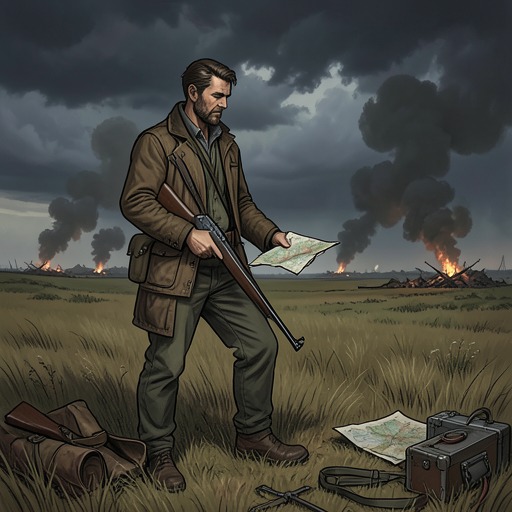
His military route did not initially take him away from Oxford. After training with a cadet battalion billeted at Keble, he received a commission as a second lieutenant in the Somerset Light Infantry, formerly the XIIIth Foot. He reached the front-line trenches on his nineteenth birthday in November 1917. Most of his service was in villages before Arras, including Fampoux and Monchy. In April 1918, he was wounded at Mt. Bernenchon, near Lillers.
Hardship, candour, and fellowship
Lewis was surprised not to dislike the army more, though he considered it detestable. The difference from Wyvern lay partly in the way hardship was named. Military life was understood as an odious necessity and an interruption of rational life; nobody insisted that the men ought to enjoy it or pretended that it was pleasurable. Lewis argues that acknowledged tribulation was easier to bear than suffering advertised as enjoyment. Shared hardship could foster camaraderie and, at its most intense, affection between those enduring it together. By contrast, enforced pleasure bred distrust, cynicism, and concealed resentment.
He also found military seniors much kinder than the Bloods at Wyvern. His explanation is partly a difference of age and maturity: men around thirty, he suggests, were naturally kinder to nineteen-year-olds than nineteen-year-olds were to thirteen-year-olds, because adults did not need the same reassurance of their status. He also wonders whether his own expression had changed. The look he had repeatedly been told to remove from his face may have disappeared, perhaps after reading Phantastes, and been replaced by one that invited pity or kindly amusement.
Lewis recalls specific instances of goodwill. On his first night in France, two middle-aged Canadian officers took charge of him among about a hundred officers sleeping on plank beds in a large hall. At the Officers’ Club in Arras, where he was dining alone with a book and wine, two senior officers invited him to join them for brandy and cigars. He stresses that such encounters were not unique, though they were particular acts rather than proof that the army was uniformly kind. His memories of those months include repeated, temporary meetings with scholars, poets, storytellers, comic companions, and other men of goodwill.
Place in the memoir
The army’s arrival is prepared by Lewis’s recognition that his future was being shaped by circumstances more immediate than academic ambition. A scholarship mattered, but the prospect of enlistment and possible death altered how he measured that importance. The memoir does not turn this into a simple rejection of study: Lewis still understood his dependence on an academic future, while also finding it difficult to treat that future as the overriding concern.
His account of military life also sharpens a recurring contrast between coercion presented honestly and coercion disguised as benefit. At Wyvern, compulsory activity could be framed as recreation even when competition and social advancement had nearly eliminated play. In the army, Lewis could regard hardship as genuinely unpleasant without being required to call it enjoyable. The contrast helps explain why he remembers fellowship among soldiers alongside the army’s real dangers, and why this period appears in the memoir as a consequential interruption rather than as a romantic escape from war.